Saturday, 25 September 2010

China's one-child policy - success or failure?

 China's One-Child Policy
On 25 September 1980, the Politburo of the Communist Party issued an "open letter" to all members of the party and the Communist youth league, urging them to take the lead in having only one child.
This is widely seen as the beginning of the controversial one-child policy.

A personal look at China's one-child policy by 

Thursday, 23 September 2010

Worlds Largest Wind Farm

The worlds largest offshore wind farm spins into life of the the Kent (Thanet) coast part of the UKs grand plan to provide 20% if its energy by renewable methods.Costing £780 and providing power for over 240,000 homes equivalent to half the houses in Kent, rising two and a half times the height of Nelsons Column.


Links
http://www.engadget.com/2010/09/23/worlds-largest-offshore-wind-farm-spins-into-action-off-the-coa/

Monday, 30 August 2010

Katrina -Then and Now

A day five years ago that changed the lives of thousands of Americans: the day that Hurricane Katrina made landfall. The water rushed in, the lights went out and for thousands of Gulf Coast residents nothing was ever the same.

CNN have released a video showing with pictures showing the days immediately after hurricane Katrina and now.

However U.S. PRESIDENT BARACK OBAMA: states " I don't have to tell you that there are still too many vacant and overgrown lots. There are still too many students attending classes in trailers. There are still too many people unable to find work. And there are still too many New Orleans folks who haven't been able to come home."


Related Resources @

Free Technology for Teachers (Fiver resources for lesson about Hurricanes)
http://www.freetech4teachers.com/2010/08/five-resources-for-lessons-about.html

Monday, 9 August 2010

The Monsoon and Impacts.

Pakistan Case Studies 2010


Rescuers are struggling to reach 27,000 people still cut off by the floods, which are the worst in 80 years.

At least 1,100 people have died and thousands have lost everything.

"In the worst-affected areas, entire villages were washed away without warning by walls of flood water," the Red Cross said in a statement.

There are fears diarrhoea and cholera will spread among the homeless. Food is scarce and water supplies have been contaminated by the floods.

Video from CNN


Pakistan floods threaten key barrage in southern Sindh

Waters have exceeded the danger level at a key flood barrier in Pakistan's southern province of Sindh.

The Sukkur Barrage flooding means Sindh faces as much devastation as that seen further north in Khyber Pakhtunkhwa and Punjab provinces, say experts.

Enraged survivors have been physically attacking government officials in flood-hit areas, amid widespread anger at the pace of the relief effort.

At least 1,600 people have died in the region's worst deluge in 80 years.

With more than 14 million people already affected, the monsoon rains show little sign of abating.

On Monday, a new international radio initiative called "info-as-aid" made its first broadcasts in Urdu and Pashto in an effort to spread information about accessing aid and also about countering disease.

TV channels 'jammed'

Flood waters have roared down from the north to the agricultural heartland of Punjab and on to Sindh along a trail more than 1,000km (600 miles) long.

In the early hours of Monday morning, the water flow coming down the Sukkur Barrage was recorded at up to 1.4m cusecs (cubic feet per second). It is only designed to withstand 900,000 cusecs.

Upper Sindh is already under water, and rescuers are continuing to evacuate people from the province, where the Indus river banks are at risk of bursting. Two million people have already left the area.

Meanwhile, two major private Pakistani television channels, Geo and Ary, have reportedly been blocked in Karachi and other parts of Sindh.

Prime Minister Yousuf Raza Gilani said the country had been set back years, as he visited Sindh on Sunday.

The entire Swat valley, in north-west Pakistan, was cut off at the weekend, with even helicopters unable to reach it because of the poor weather.

With roads, bridges and railway tracks washed away, and deadly landslides increasing the isolation of many of the worst-hit areas, aid workers are having to use donkeys to deliver relief.

"It's hard to get supplies there. I would like to emphasise we are moving by foot or donkey. We are unable to get in to most places of Swat valley," Maurizio Giuliano, spokesman for the UN Office for the Co-ordination of Humanitarian Affairs, told news agency Reuters.

In the far north of the country, dozens of people were killed on Saturday when two villages were buried in mud and rocks. Nearly 30 bodies were recovered from rubble after landslides in Gilgit-Baltistan province.

The UN has said that Pakistan will need billions of dollars in aid to recover.

Meanwhile, charities with links to militants have been delivering aid to thousands of flood victims, as they did during the earthquake that devastated part of Pakistani-administered Kashmir in 2005.


Related Links

Uncertainties surround future monsoons(2009)  

Pictorial Record of the disaster.

Smos Satellite Tracks Pakistani Floods


Saturday, 31 July 2010

Further Chile Earthquakes possible.

Chilean authorities are working with seismologists in order to prepare for a possible earthquake that could strike the country "any day".

Research scientist said the 8.8-magnitude earthquake was "the fifth largest event in modern seismology" and prior to the earthquake in February scientists had warned the Chilean government of the possiblilty of a large earhquake and tsunami several months before.


Dr Melnick said "Scientists met with authorities in Talcahuano several months before the earthquake," he told BBC News. "And they warned them that there was a possibility of an earthquake and of a big tsunami.

However the authorities did not take them seriously and believed if you forecast an earthquake people would begin to panic.

Exact forecast

Dr Melnick said that the latest study showed that the predictions were correct, and called February's disaster a "wake-up call" for the local authorities.

The team measured the coastal level changes right after the earthquake to calculate the size of the rupture and then determined how much "slip" was released during the shaking.

Slip is the displacement that results when the tectonic oceanic plate jumps back like a spring during an earthquake after years of compressing the continental plate.

Almost 500 people died during the last earthquake in Chile They found an average slip of 10m - very similar to the forecasted data of 11.9m.

Dr Melnick explained that to predict an earthquake's magnitude, seismologists multiply plate convergence rate by the number of years since the last great event.

*Prediction of magnitude= convergence rate x seismic gap(years since last great event)*


"There was an earthquake in south-central Chile in 1835 and it was well documented by FitzRoy and Darwin, [with the data of] land level changes and a tsunami that followed.

"So that means that if we know that a region has not experienced an earthquake in 175 years, then we can say that there is about 11m of slip ready to be released. This way you can estimate the magnitude. And that's very important to know to prepare for it," said Dr Melnick.

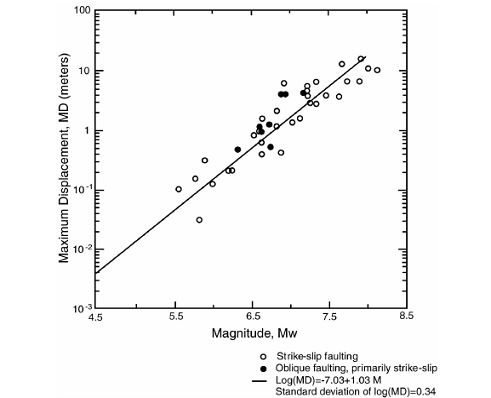
Slip displacement and magnitude


So for example if the expected slip movement is 10m this gives you an approximate earthquake magnitude of over 7.5


Using the same method, scientists determined another area that was "ready" for a potentially devastating shaking - northern Chile, close to the border with Peru.


"The region hasn't ruptured since 1877. We can estimate that it is ready for another magnitude 8 or 8.5 earthquake any day - it could happen tomorrow or it could happen in the years to come," he said.

Resource link @

http://www.bbc.co.uk/news/science-environment-10822259

http://www.fhwa.dot.gov/bridge/tunnel/pubs/nhi09010/13a.cfm

Sunday, 4 July 2010

Gulf of Mexico Oil Leak Simulation


Detailed simulations of the Gulf of Mexico oil leak show that crude is likely to start spreading into the Atlantic Ocean soon. Once oil becomes caught in the Gulf of Mexico's fast moving Loop Current, it could be carried thousands of miles, around Florida, up the Atlantic coast of the US, and then out into the open ocean.
The cost of cleaning up the oil spillage in the Gulf of Mexico now runs into billions of dollars, according to BP estimates.

The company has tried a number of methods to shut down the leak from the damaged oil well - often innovating as subsequent attempts have failed.


Although some of the methods have been tried and tested at incidents elsewhere in the world, they have not been carried out at such great depth as the Deepwater Horizon leak - 5,000 feet (1.5km) below the surface, see stopping the oil and interactive guide


Links @
http://news.bbc.co.uk/1/hi/science_and_environment/10492086.stm
http://news.bbc.co.uk/1/hi/world/us_and_canada/10317116.stm

Monday, 26 April 2010

6 volcanoes that could shut down the world

A worrying look at six volcanoes that could have devastating impacts on the world and civilisation.

Here is a taster from the article by the Week.:-

YELLOWSTONE "SUPERVOLCANO" (U.S.)


Last erupted: 640,000 years ago

Effects of a major eruption: When the Yellowstone Caldera, or "supervolcano," in Yellowstone National erupts again, it will render a huge swath of North America, from Vancouver to Oklahoma City, uninhabitable. It would have incalculable human and economic consequences. The last eruption of similar magnitude — 73,000 years ago in Sumatra — plunged the entire planet into a decade-long volcanic winter and nearly wiped out the human race.

Likelihood: Geologists see signs that it could be preparing for another major blowout soon, although "soon" could mean thousands of years.
 
Volcanic Explosive Index (VEI)of 7


Sources @